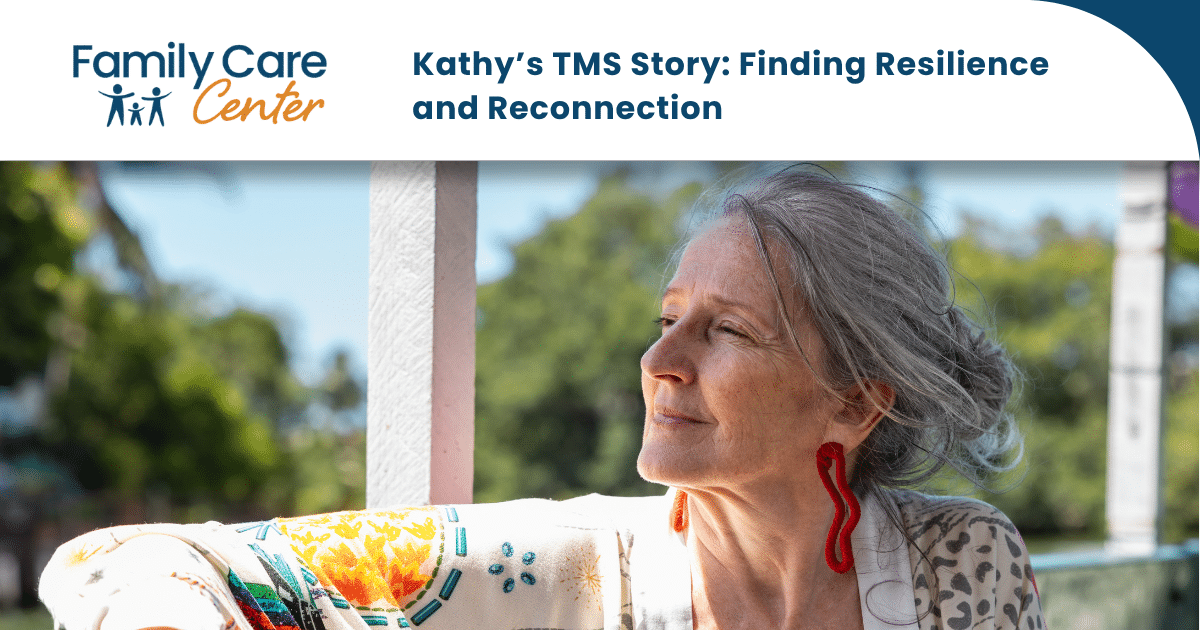
Nearly a decade after transcranial magnetic stimulation (TMS) helped Kathy move through depression, she never expected to need that kind of support again. But after a series of painful losses, a serious fall, and growing anxiety began to change the way she lived and worked, Kathy knew she needed help.
She found that help at Family Care Center Mesa, where her care team took a comprehensive approach to treatment, combining therapy and TMS to help her find her footing again and reconnect with the parts of life she had been missing.
Finding her way back after a difficult year
Kathy was first treated for depression about 10 years ago at another behavioral health organization.
“I never saw my psychiatrist there, and that was really difficult for me,” she shared. “There were so many different nurse practitioners treating me. I wasn’t comfortable with my meds, and it eventually led to me breaking down in a session.” That breakdown led her psychiatrist to step back in and recommend a more stabilizing treatment plan.
He started her with TMS paired with ketamine treatment, and that helped her regain her footing. Kathy went on to do well for many years and built a life that felt steady and fulfilling.
Then, one difficult event followed another. Kathy lost a close friend, followed by her dog. After that, a fall resulted in a head injury and a trip to the trauma emergency room, and she began using a walker to get around. The losses and physical changes began to affect her work, her stress levels, and her ability to experience joy.
“My stress level and anxiety were really high because of the multiple losses I experienced,” Kathy said.
Her boss encouraged her to seek counseling, and Kathy found Family Care Center through her insurance. She reached out and was able to begin therapy the following week.
For Kathy, that first step opened the door to something she had not expected: a chance to look at everything she had been carrying and find a path forward.
Processing pain with EMDR before restarting TMS
Because Kathy had experienced TMS before, she was familiar with the treatment and open to trying it again. But before doing that, her Family Care Center team focused on therapy and EMDR to help her work through the grief and trauma she was carrying.
EMDR, or eye movement desensitization and reprocessing, is a structured therapy that helps people process painful or traumatic memories, so they feel less overwhelming. For Kathy, this work provided an important foundation as she continued her treatment.
Her care team included therapy with Harrison Crawford and EMDR with Seth Herbel. While Kathy was working through therapy, the team also worked through the approval process for TMS. Once it was approved, she moved her medication management to Obumneke Ugbor at Family Care Center, allowing her providers to coordinate her care in one place.
A personalized approach to TMS
When Kathy began TMS at Family Care Center, her treatment was tailored to the symptoms she was experiencing. Her care team explained the process and what to expect, including the mapping used to personalize her treatment.
She also had the option of sequential bilateral (SBL) TMS, an approach designed to address both depression and anxiety. The sequential bilateral method combines an FDA-approved protocol to the left side of the brain, followed by an evidence-based protocol to the right side of the brain in a novel approach, offering the potential for higher response and remission rates, providing patients with an advanced option for more complete recovery.
“The team was really great at explaining what was going on,” Kathy said. “My therapist was kind enough to join me during my mapping, and my TMS tech Suzi Krstic was always such a pleasure to talk to during my sessions.”
Building resilience and reconnecting with family
Near the middle of her TMS treatment, Kathy experienced an unexpected interruption when she was hospitalized for three days for an unrelated condition. She paused TMS while she recovered and took the time she needed to regain her strength. During the break, she noticed that some of the progress she had been feeling began to fade, reinforcing how much the treatment had been helping. When she was ready, Kathy returned to TMS and continued her treatment plan.
As TMS treatment continued, Kathy began noticing more moments of clarity and happiness that had felt out of reach. She completed her final TMS session in July 2026 and has continued to feel well since then.
“If something negative happens in my life now, I just deal with it. I have more resilience these days,” she said.
The changes Kathy experienced have extended beyond her mental health. After being estranged from her family since 1987, she reached out to a cousin following her treatment. The two now stay in touch by email, share photos of family members, and exchange letters, a reconnection that has brought Kathy tremendous happiness.
“I’m so happy to be reconnected with them,” she said.
Kathy has completed her TMS treatment and continues therapy, EMDR, and medication management at Family Care Center as she builds on her progress.
For anyone considering TMS, Kathy has simple advice: Don’t let the time commitment hold you back.
“TMS was well worth the time and effort I put in,” she said. “I am less stressed and am enjoying my life.”
Read more patient stories
Every mental health journey is different. If Kathy’s story spoke to you, we invite you to read more patient stories from Family Care Center. These experiences show the many paths people take toward healing, supported by caring staff, proven treatments, and a team that truly listens.