
mental health outcomes
More Than 8 in 10 Patients Experience Meaningful Improvement
At Family Care Center, we believe in practicing compassionate, evidence-based mental health care and measuring the results. Our patients consistently achieve meaningful improvements through coordinated, personalized care.
Across all services, 84% of patients experience a clinically significant reduction in depression and anxiety symptoms — well above national outpatient behavioral health benchmarks, which are 52% (Blueprint Quality Index). It’s care that works — proven by real outcomes.
Leading the way in innovation & outcomes
At Family Care Center, we’re setting a new standard for mental health care. While the national benchmark for positive mental health outcomes is 52%, our data shows we consistently achieve significantly higher results—demonstrating our commitment to transforming lives and behavioral health.
84% Experience a Decrease in Depression
When treated for depression, 84% of Family Care Center patients experience a significant decrease in symptoms within six months.
84% Experience a Decrease in Anxiety
When treated for anxiety, 84% of Family Care Center patients experience a significant decrease in symptoms within six months.
Even better results with integrated care
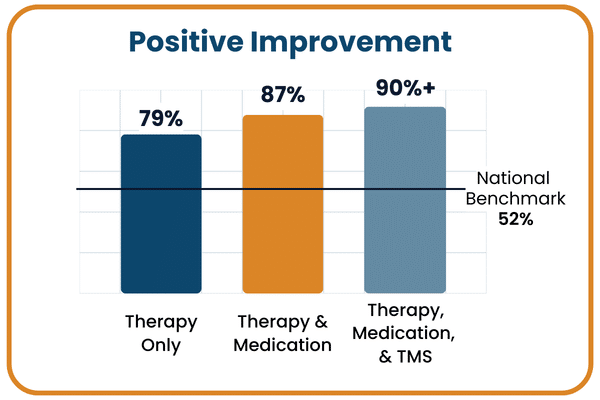
- When we treat people for depression and anxiety using talk therapy alone, 79% experience a significant decrease in their symptoms within six months.
- Our patients whose treatment plans include both therapy and medication management experience even better results with 87% reporting a significant decrease in their anxiety and depression symptoms within six months.
- When patients participate in integrated therapy, medication, and TMS care, 90%+ experience clinically significant positive outcomes for depression and anxiety.
Specialty programs for higher levels of support
Our specialty services — including transcranial magnetic stimulation (TMS) and mental health Intensive Outpatient Programs (IOP)— expand the ways we support people on their path to healing. These evidence-based treatments are designed to reach individuals who may benefit from a higher level or different approach to care.
Transcranial magnetic stimulation (TMS)
TMS is an evidence-based, non-invasive treatment for individuals with treatment-resistant depression and anxiety. Guided by clinical standards and best practices from Family Care Center’s TMS Center of Excellence, care prioritizes safety, consistency, and measurable outcomes.
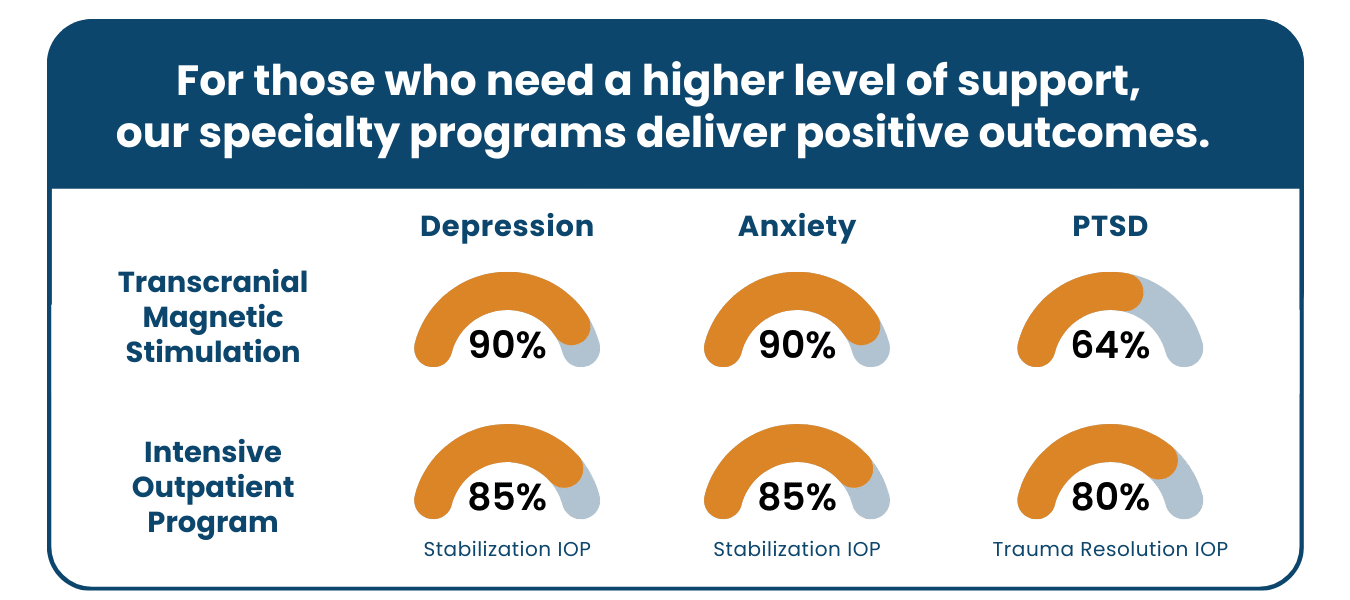
- 90% of patients receiving TMS for depression experience improvement
- Similarly, 90% of patients treated for anxiety report positive outcomes
- Even among individuals facing the complex challenges of PTSD, 64% show measurable improvement
These results speak to the effectiveness of TMS as a targeted, evidence-based intervention that can help restore hope when other approaches have fallen short.
Mental health Intensive Outpatient Programs (IOP)
Our IOP offers a structured, higher level of care than routine appointments while providing flexibility outside the constraints of inpatient treatment. IOP is ideal as a step-down from inpatient care or as a proactive alternative to avoid hospitalization.
- 85% of patients in our IOP Stabilization track see measurable improvement in their depression symptoms
- 85% of those in our IOP Stabilization track experience positive anxiety outcomes
- For patients participating in our IOP Trauma Resolution track, 80% show improvement in PTSD symptoms
These outcomes reflect the impact of comprehensive care that integrates therapy, psychiatric support, and skill-building in a collaborative environment.
Research-guided, results-driven care
Research at Family Care Center guides our care delivery, progress measurement, and ongoing improvement. Each insight sharpens our approach, ensuring patients get the right treatment at the right time, for exceptional results.
We are among the few behavioral health organizations in the country with a dedicated research team focused on advancing clinical innovation and improving patient outcomes. Our research department is housed within our Family Care Center TMS Center of Excellence, creating a direct connection between scientific discovery and clinical practice.
Our research helps us better understand complex mental health conditions and test new treatments, focusing on areas like transcranial magnetic stimulation (TMS) and integrated care. We conduct clinical studies on novel TMS protocols for depression, anxiety, PTSD, and related psychiatric conditions. We share our findings at national and international conferences and publish them in peer-reviewed journals, such as Transcranial Magnetic Stimulation, Brain Stimulation, and Psychiatric Services.
To evaluate effectiveness, Family Care Center regularly reviews aggregated patient-reported outcomes. This allows us to:
- Personalize treatment – tailor each patient’s care plan based on their unique needs
- Adjust care plans as needed – use ongoing symptom tracking and patient-reported outcomes to make real-time modifications
- Ensure patients receive the right care at the right time – leading to more meaningful, measurable improvements in mental health
Why we measure
Measuring outcomes allows Family Care Center to understand how patients are responding to care and to make informed adjustments to treatment plans when needed.
One commonly used tool is the PHQ-9 (Patient Health Questionnaire-9), a validated measure for assessing symptoms of depression. A clinically significant response is defined as either:
- A decrease of at least 5 points within six months, or
- A total score of 9 or lower, indicating fewer reported depressive symptoms.
Lower scores reflect a reduction in symptom severity. By using the PHQ-9 and other validated clinical tools at regular intervals, providers can monitor progress, support shared decision-making, and tailor care to each individual’s needs.
Additionally, we use our own functionality scale to measure meaningful outcomes. The functionality scale measures how well a person is able to participate in all aspects of their lives and how they improve over time. By tracking changes in work and daily activities before and after treatment, it provides clinicians, patients and family members with a comprehensive perspective on the effectiveness of the treatment.
About the data
Depression data: We analyzed patient data that was collected from Jan. 1, 2023, through Dec. 31, 2025. The 20,339 patient episodes of care in this sample were 18 years of age or older, had a diagnosis of a depressive disorder, scored 10 or above on a PHQ-9, and had at least one other PHQ-9 during a period of six months. Patients may have received any combination or single service, including, but not limited to, therapy, medication management, and TMS.
Anxiety data: We analyzed patient data that was collected from Jan. 1, 2023, through Dec. 31, 2025. The 21,545 patient episodes of care in this sample were 18 years of age or older, had a diagnosis of a depressive disorder, scored 10 or above on a GAD-7, and had at least one other GAD-7 during a period of six months. Patients may have received any combination or single service including, but not limited to, therapy, medication management, and TMS.
Integrated care data: We analyzed patient data that was collected from Jan. 1, 2023, through Dec. 31, 2025. The 14,338 patient episodes of care in this sample were 18 years of age or older, had a diagnosis of a depressive disorder, scored 10 or above on a PHQ-9, and had at least one other PHQ-9 during a period of six months. Patients received therapy, medication management, and TMS.
IOP data: We analyzed patient data that was collected from May 1, 2024, to Dec. 31, 2025. The 26 patient episodes of care in this sample were 18 years of age or older, scored 10 or above on the PHQ-9, and had at least one other PHQ-9 during a period of six months. Patients may have received any combination of other services in addition to IOP, including, but not limited to, therapy, medication management, and TMS.
Industry benchmark: Industry benchmark information is derived from the Blueprint Quality Index, which is one of the largest outpatient behavioral health data repositories available. The data includes over two million outcome measure administrations from over 200,000 patients.
FAQs about mental health outcomes
Measurement-based care is an approach that uses regular symptom assessments to guide treatment decisions. Research shows it can improve outcomes by helping clinicians identify what is working and when adjustments are needed.
Outcomes are measured using validated mental health questionnaires such as the PHQ-9, GAD-7, and PCL-5, which track symptom severity over time and help guide care decisions.
Family Care Center’s integrated care model delivers 79–90%+ positive outcomes for depression and anxiety — significantly higher than national benchmarks. IOP outcomes remain strong across conditions, and TMS demonstrates both high efficacy and long-term durability.
It means a measurable reduction in symptoms that meets established clinical thresholds, such as a five-point decrease on the PHQ-9 or a score below the clinical range.
Outcomes are typically evaluated over a six-month period, though some patients improve sooner and others more gradually depending on diagnosis and treatment type.
Data shows higher improvement rates when therapy is combined with medication management or TMS compared to therapy alone for some patients.
Yes. Results are based on aggregated, de-identified data collected from adults receiving behavioral health care at Family Care Center during defined time periods.
Get started with care
Taking the first step on your mental health journey is easier than you might think.
- Call or request an appointment online to speak with our team about care and coverage
- Let us know how we can support you or your loved ones
- Choose a time, provider and location near you - also available virtually