
DJ didn’t end up at Family Care Center because of one bad day. It was years of little things adding up and a quiet heaviness he just couldn’t shake.
Some mornings, getting out of bed felt like climbing a mountain. He felt empty inside. Motivation came and went without reason. It was a recognizable pattern that would occur every now and then. But over time, the pattern felt less like something temporary and more like something he might never fully escape.
Then, in October 2025, the weight became impossible to ignore. The anniversary of his mother’s passing hit like a wave. At the same time, he was going through a difficult breakup. Grief and heartbreak piled on, and it started to feel suffocating.
There was no intent to end his life, but he didn’t want to exist for a while. That scared him enough to reach out for help.
Finding support at Family Care Center
DJ’s primary care physician was referred him to Family Care Center Louisville, where he was matched to his therapist, Nikki Rossetter, LPC.
He’d been diagnosed with generalized anxiety before, but until meeting with Nikki, he didn’t realize it actually began in middle and high school. He recalled long periods of what felt like dipping and resurfacing, but he always returned to himself. Through Nikki’s help, he began to understand the long-term effects of repeated depressive episodes. That realization shifted his perspective on his condition and how to effectively treat it.
Over the years, DJ tried a few medications prescribed by his doctors. The first Selective Serotonin Reuptake Inhibitor (SSRI) helped with sleep and impulse control, but dulled parts of him. Creativity faded; focus dulled.
So, he made the decision to stop the medication, but depression and anxiety returned.
He was then prescribed a norepinephrine-dopamine reuptake inhibitor (NDRI). It helped in certain ways, but brought irritability he hadn’t expected. The people around him noticed that he wasn’t himself.
“It started to feel like every option helped with one thing but took something else away,” DJ shared. “It was as if I was trading one struggle for another”.
Rebuilding his life one habit at a time
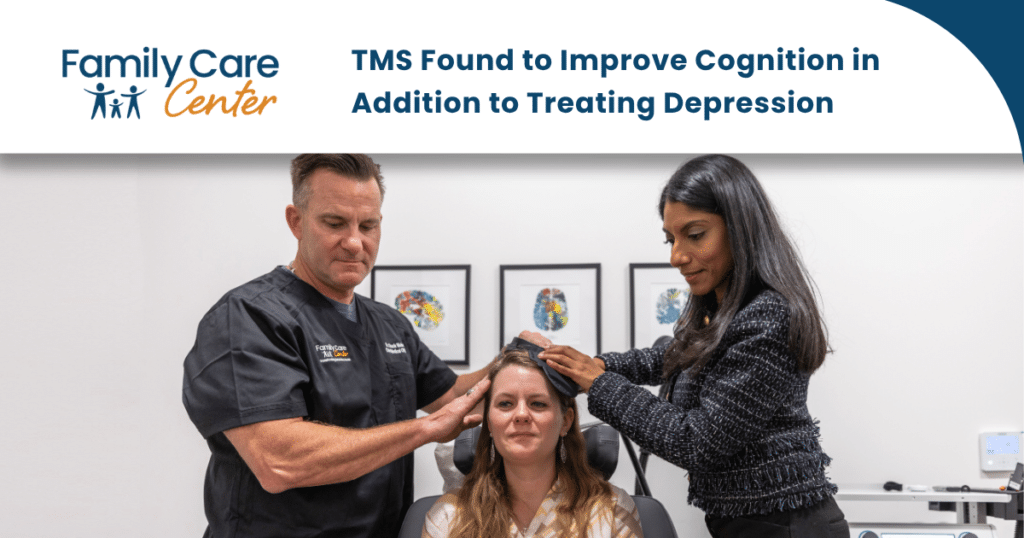
When DJ shared his concerns about medication, Nikki and Physician Assistant Haleigh Zwart at the Louisville clinic, took the time to really hear him. Instead of offering another medication that didn’t feel right, they introduced him to transcranial magnetic stimulation (TMS). It felt like the start of something new. A little unfamiliar, a little scary, but also quietly hopeful.
What made the biggest difference was the way DJ’s team framed it. TMS wasn’t presented as a last resort. It was presented as a way to invest in himself and his future.
As he met with Nikki, Haleigh, and his psychiatrist, Dr. Natasha Ziv, he began to feel something he hadn’t felt in a long time. Supported. Seen. Surrounded by people who were working with him, not just treating him.
“There was a sense of being supported by a full team, not just one provider,” he said. “Therapy, medication management, and treatment planning all felt connected.”
– DJ
“There was a sense of being supported by a full team, not just one provider,” he said. “Therapy, medication management, and treatment planning all felt connected.” That connection mattered more than he expected, and so did the habits he was quietly building.
Before beginning TMS, DJ started rebuilding the rest of his life, too. He signed up for the Colfax Half Marathon and began training, working in road running and trail running. He got back to lifting weights. He ate more intentionally, slept more consistently, and created healthy routines.
These weren’t big, dramatic changes. They were small, steady habits that helped him feel like he was slowly coming back to himself.
What TMS felt like: nervous beginnings, unexpected comfort
On his first day of TMS, he still felt nervous. The sessions sounded like they’d be long. The experience was unfamiliar. He knew he’d have to talk to a stranger every day for 30 minutes.
But there was also something else beneath it: a quiet optimism that maybe this was the turning point. He credits his care team for the comfort they brought.
- Dr. Ziv was empathetic and scientific as she expertly navigated finding his TMS target during mapping.
- DJ was paired with his TMS Tech Leon, who not only administered his treatments but helped make the process feel steady and human. What he expected to feel clinical turned out to be surprisingly grounded. Even something he had been anxious about—spending time in treatment sessions—started to feel like a structured pause in the week rather than something to dread. He looked forward to “meeting up with Leon” during a work break each day.
- Nikki continued to see him for weekly therapy sessions and to provide him with the tools needed to feel present and stay engaged in the work he was already doing.
Initial results from TMS
As the first week passed, something began to shift. DJ described it as “the difference between being stuck in a sand pit and being handed a rope.” Before, there was always a sense of sinking, no matter how hard he tried. But as he continued to show up for TMS, there was something to hold onto.
Gradually, as treatment progressed, the feelings that weighed him down grew less constant. There were moments of clarity he hadn’t experienced in years. Situations that once would have triggered spirals didn’t take over in the same way. He could sit in conversation without overanalyzing every word. He could be present amongst friends and coworkers.
A small moment that showed him how far he’d come
Near the end of his treatment, life still happens as it always does. One day, on the way to work, DJ got into a minor fender bender. It wasn’t serious, but it was the kind of situation that would have overwhelmed him in the past.
Instead, he handled it. He dealt with what needed to be done. There was stress, but no collapse. It didn’t become the center of his world.
That moment stayed with him.
How DJ’s life has changed
DJ finished TMS in April 2026. Today? Life isn’t perfect. Stress hasn’t vanished. But he can manage it. If anxiety creeps in, he knows why—lack of sleep, travel, routine changes. It’s not a mystery. It doesn’t spiral.
For the first time in a long time, DJ doesn’t feel like he’s carrying the same weight everywhere he goes. What once felt like a mountain now feels like a hill he can climb.
Read more patient stories