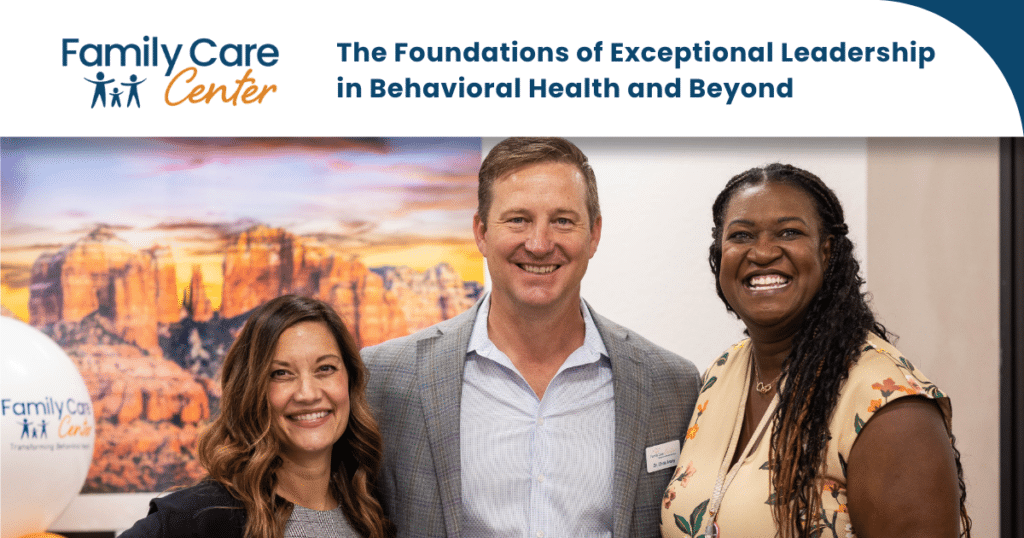

At Family Care Center, developing exceptional clinical leaders means learning from people who have led through extraordinary circumstances.
As part of our Clinical Leadership Series, our leaders recently heard from retired U.S. Army Major General Dr. Bob Ivany, whose career spans more than three decades of military leadership, service in the Reagan White House, higher education, executive coaching, and nonprofit leadership.
Throughout his presentation, one message recurred: leadership begins with empathy.
Not empathy as a soft skill, but as a deliberate leadership practice that builds trust, strengthens teams, and improves the care we provide to patients.
Empathy is more than understanding
Dr. Ivany challenged leaders to think differently about empathy.
Understanding how someone feels is only the first step. True empathy also requires the courage to acknowledge those feelings and communicate that understanding.
In behavioral health, this matters at every level. Clinicians build trust with patients through empathy, and leaders build trust with clinicians the same way.
“Trust comes with time, commitment, and courage,” Dr. Ivany shared.
When leaders consistently demonstrate empathy, people feel seen, respected, and safe enough to do their best work.
Small moments build lasting trust
One of Dr. Ivany’s earliest lessons in leadership came during his time serving as President Ronald Reagan’s Army aide.
Before meeting him for the first time, President Reagan had taken time to read Dr. Ivany’s biography. Rather than beginning with military business, Reagan noticed they had both played college football.
That brief conversation lasted only a few minutes, but it left a lasting impression.
By finding common ground first, Reagan established an immediate sense of connection and trust.
For leaders, Dr. Ivany said, those small moments matter. Taking two minutes to ask a question, remember something personal, or make someone feel valued can have an impact far greater than the time invested.
Leadership shows up when people need it most
Some of Dr. Ivany’s most memorable leadership lessons came during moments of tragedy.
In 1985, Dr. Ivany witnessed a powerful example of leadership during tragedy following the plane crash of Arrow Air Flight 1285 in Gander, Newfoundland. The flight was carrying members of the 101st Airborne Division home from a six-month peacekeeping deployment, leaving families at Fort Campbell awaiting loved ones who would never return.
President Reagan traveled to Fort Campbell to meet with grieving military families. Rather than simply attending the ceremony, he chose to walk through every row of surviving spouses, stopping to embrace each person individually, even though it disrupted the carefully planned schedule.
For Dr. Ivany, the lesson was simple. Great leaders do more than what is required. They lead with empathy.
Looking someone in the eye, taking the time to acknowledge their pain, and letting them know they are not alone are acts of leadership that people remember long after the words have faded.
Empathy doesn’t require agreement
Dr. Ivany reminded leaders that empathy is often misunderstood. It does not mean agreeing with someone’s opinions or decisions. It means respecting their humanity.
He shared examples from both politics and diplomacy in which leaders with deeply opposing viewpoints were still able to build meaningful relationships because they took the time to understand one another as people first. Those relationships created opportunities for dialogue that would never have existed otherwise.
Behavioral health leaders face similar challenges every day. Patients, families, and coworkers all bring different experiences and perspectives. Leadership begins by seeking understanding before judgment.
The best leaders never stop learning
Empathy also requires curiosity.
During the Cold War, Dr. Ivany watched President Reagan intentionally study Russian history and culture before entering negotiations with Soviet leader Mikhail Gorbachev.
Rather than assuming he already knew enough, Reagan invited Russian scholar Suzanne Massie to the White House repeatedly to deepen his understanding of the people behind the politics.
His willingness to learn ultimately strengthened one of the most important diplomatic relationships of his presidency.
For clinical leaders, the lesson is equally relevant. Understanding another person’s experience requires humility and the willingness to keep learning.
Leadership is about people
Near the end of his presentation, Dr. Ivany reflected on another unexpected lesson.
While teaching at West Point, he questioned why leadership expert Frances Hesselbein, former CEO of the Girl Scouts of the USA, had been invited to speak to military officers and combat Veterans. By the end of her presentation, he understood.
Leadership principles are universal. Regardless of industry, title, or experience, the leaders who make the greatest impact are the ones who genuinely care about people.
A lasting reminder
Dr. Ivany closed with a message that resonates deeply within behavioral health: empathy is not only something patients need from their providers, but also something providers need from one another.
Empathy is not only something patients need from their providers. It is something providers need from one another.
When leaders create workplaces grounded in trust, curiosity, honesty, and compassion, everyone benefits from clinicians and staff to the patients they serve. That is the kind of culture that sustains exceptional care.
This conversation is part of Family Care Center’s Clinical Leadership Series, which brings nationally respected leaders to our organization to help strengthen leadership through shared learning, practical experience, and meaningful reflection. By investing in our clinical leaders, we continue to build a culture in which exceptional leadership drives exceptional patient care, and that care is sustained by empathy.