
Adults can lose focus, forget an appointment, or feel overwhelmed from time to time. Those experiences do not mean a person has an attention-deficit/hyperactivity disorder (ADHD). Adult ADHD symptoms are part of a lasting pattern that can make work, relationships, and daily tasks harder. Family Care Center supports adults with ADHD and other mental health concerns through care based on each person’s needs.
ADHD starts in childhood, but some people are not diagnosed until adulthood. Symptoms can also change as life becomes more demanding. An adult may not seem very active on the outside but may still feel restless. They may also have trouble with focus, planning, or impulse control. Learning about common ADHD symptoms in adults can help you decide when it may be useful to talk with a mental health professional.
8 adult ADHD symptoms
ADHD can involve problems with attention, activity level, impulse control, or a mix of these. Signs may appear at work, at home, in relationships, and during routine tasks. One behavior alone is not enough to show that someone has ADHD. Providers look for a pattern that lasts over time and affects daily life.
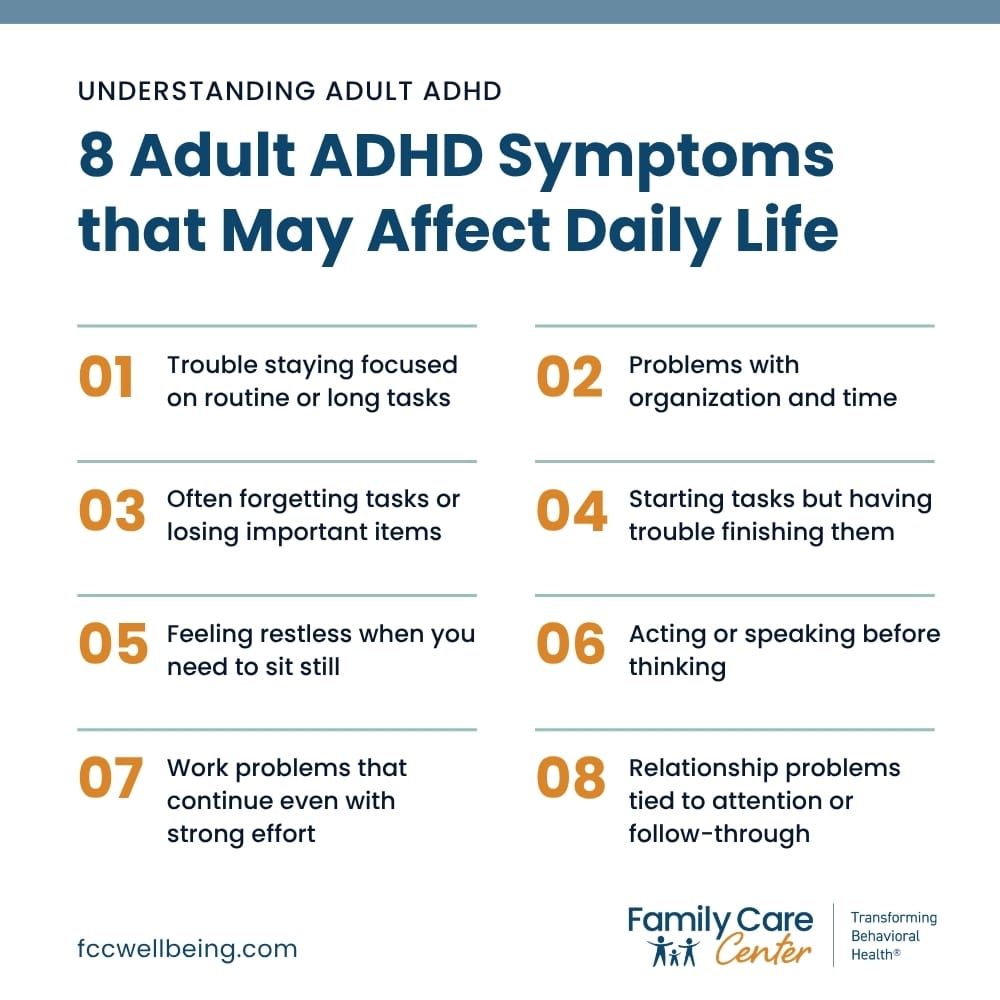
1. Trouble staying focused on routine or long tasks
Some adults with ADHD have a hard time staying focused on tasks that feel repetitive or take a long time. They may read the same paragraph several times. They may lose track during a meeting or drift away during a conversation, even when they want to listen.
Everyone gets distracted sometimes. Poor sleep, stress, or a busy day can make focus harder. With ADHD, attention problems happen often and can affect more than one part of life.
2. Problems with organization and time
ADHD can make planning and time management harder. An adult may think a task will take 20 minutes when it takes an hour. They may miss deadlines or feel unsure where to start when several tasks need attention.
At work, this may look like late projects, missed meetings, or unfinished paperwork. At home, it may include unpaid bills, clutter, missed errands, or a schedule that feels hard to manage.
Mental health in the workplace can be affected when focus and organization problems make everyday duties harder.
3. Often forgetting tasks or losing important items
Everyone loses things once in a while. For adults with ADHD, this may happen often enough to cause problems. Keys, phones, papers, medications, or work items may go missing again and again.
An adult may also forget appointments, return calls late, or miss tasks they meant to finish. This does not always mean the person is careless. A repeated pattern may point to problems with attention, memory, or organization that are worth discussing with a provider.
4. Starting tasks but having trouble finishing them
Some adults with ADHD find it easier to start a task than to finish it. They may move from one project to another before the first one is done. This can be harder when a task has many steps or requires focus for a long time.
Other concerns can cause similar problems. Stress, anxiety, depression, poor sleep, and some health conditions can also make it hard to finish tasks. A professional evaluation can help sort out what may be happening.
5. Feeling restless when you need to sit still
Hyperactivity in adults may look different than it does in children. An adult may not run around or leave their seat often. Instead, they may feel restless inside, fidget, shift positions, or feel a strong need to stay busy.
Long meetings, quiet activities, or waiting can feel hard. Some adults take on many tasks because slowing down feels uncomfortable. Others tap a foot, move their hands, or get up often.
Restlessness can have many causes. It is not enough on its own to show that someone has ADHD.
6. Acting or speaking before thinking
Impulsivity means acting quickly without fully thinking through what may happen next. An adult may interrupt someone, finish another person’s sentence, buy something without planning, or agree to a commitment too quickly.
Most people make quick choices sometimes. With ADHD, impulsive behavior is more likely to happen often and create problems. It may cause tension with coworkers, family members, or partners.
7. Work problems that continue even with strong effort
Adult ADHD symptoms may become easier to notice when work gets more complex. Email, meetings, deadlines, and several projects at once all require planning and focus. A person may work extra hours to keep up but still miss details or deadlines.
ADHD can affect work, but work problems do not prove that someone has ADHD. Burnout, poor sleep, anxiety, depression, lack of training, or a heavy workload can also affect focus and performance.
8. Relationship problems tied to attention or follow-through
ADHD can affect communication and shared tasks. A partner may feel unheard when conversations are interrupted or forgotten. Friends may feel hurt when plans are missed. Family members may become frustrated when chores are not completed.
These problems do not mean a person with ADHD does not care. But repeated problems with attention, planning, or impulse control can create stress in relationships.
Therapy may help adults learn better communication skills and practical ways to manage these patterns. It can also help people understand how ADHD symptoms may affect daily life.
When adult ADHD symptoms may need an evaluation
Many people will recognize one or two signs on this list. That does not mean they have ADHD. For a diagnosis, providers look for a group of symptoms that lasts at least six months and causes problems in daily life. Symptoms must also show up in more than one setting, such as at work and at home. For adults, there must be signs that symptoms were present before age 12.
A full evaluation looks at more than a checklist. A provider may review:
- Current symptoms — How often the concerns happen and how long they have been present.
- Childhood history — Whether similar problems were present before age 12.
- Daily impact — How symptoms affect work, home, relationships, and other tasks.
- Other health concerns — Whether sleep, mood, substance use, medications, or health problems may be playing a role.
A provider may also use rating forms or ask for information from a partner or family member.
An ADHD evaluation should also look for other possible causes.
- Anxiety, depression, poor sleep, substance use, learning differences, and some health conditions can cause similar problems.
- Some adults have ADHD and another condition at the same time.
- It is also common for symptoms of trauma, personality disorder, or other dysregulations to manifest as inattentiveness, emotional lability, or scattered thinking.
The goal is to understand the full picture before choosing treatment.
What support for adult ADHD can include
Treatment depends on the person. A care plan may include medication, therapy, practical skills, or a mix of these options. The best plan depends on the diagnosis, health history, symptoms, and personal goals.
- Medication may help some adults manage ADHD symptoms. A qualified prescriber should review possible benefits, side effects, and other treatment choices before medication begins.
- Therapy can help with time management, organization, communication, and emotional stress. Practical tools may include using reminders, breaking large tasks into smaller steps, reducing distractions, and creating simple routines.
Treatment should be a shared process. A provider and patient can review what is helping and make changes when needed.
How Family Care Center can help you understand adult ADHD symptoms
If problems with focus, organization, restlessness, or impulse control are making daily life harder, Family Care Center can help you take the next step without assuming a diagnosis. Our mental health professionals can listen to your concerns, review your history, and help decide what type of evaluation or care may fit your needs.
Family Care Center offers individual therapy, psychiatric care, and medication management through coordinated outpatient teams. Care is based on the whole person. An evaluation may point to ADHD, another mental health condition, more than one concern, or a different reason for the symptoms.
You do not need to decide on your own whether your experiences are ADHD. A professional conversation can help you better understand what is happening. Family Care Center can help you connect with a provider, review your options, and decide on a next step that fits your needs. Contact our team today for more information or to schedule an initial appointment.