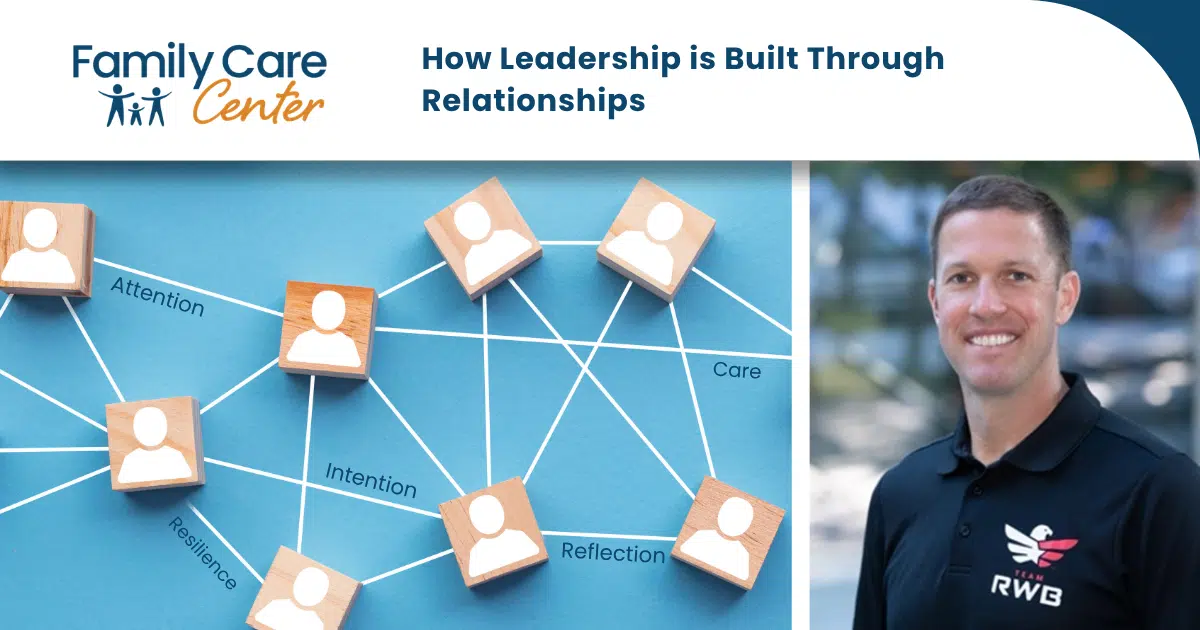
At Family Care Center, we believe strong clinical leadership is built through connection, reflection, and shared learning. As part of our ongoing leadership talk series, we recently welcomed Mike Erwin for a conversation with our clinical leaders.
Erwin, a leadership expert and co-author of Lead Yourself First and Leadership Is a Relationship, focuses on how leadership is built on character and strong relationships.
Erwin founded The Character & Leadership Center and serves as its CEO. He graduated from West Point, served as a U.S. Army Intelligence Officer, and is now a Lieutenant Colonel in the Army Reserves. He went to the U.S. Military Academy at West Point and now teaches at his alma mater.
No matter what audience he is speaking to, Erwin emphasizes that leadership only works when relationships are genuine, not just transactional. At Family Care Center, this matches how we support each other and our patients every day. Care, trust, and teamwork are built through real relationships, not by chance.
Leadership is complex
Leadership is rarely straightforward. People respond differently to stress, pressure, and change. Some handle tough situations well, while others struggle. Personal life circumstances can also affect performance in ways leaders might not see.
This complexity raises key questions:
- How well do you know the people you lead beyond their roles?
- How do stress and personal life affect performance?
- How do you lead when things are not going well?
- And how do you build true team cohesion when individual performance varies so widely?
Erwin stressed that leadership comes with real responsibility. People rely on leaders for clarity and direction, especially when things are uncertain. This responsibility should lead to greater awareness, not more control.
Leadership is not transactional
A key point from the discussion was that leadership is about relationships, not just transactions.
“Having people finish tasks is not the same as leading them,” Erwin said. “Good leadership happens when people feel understood, supported, and connected to a common goal.”
“When leaders invest in relationships by learning about people’s values, strengths, and challenges, teams are more willing to take on difficult work,” he added. “Trust increases, accountability strengthens, and collaboration improves.”
Lead yourself first
Leaders need to learn how to lead themselves before they can lead others well.
“Lead Yourself First” is not a concept—it is a discipline. It means intentionally creating space to think, reflect, and align actions with values before reacting to external demands.
At its core, leading yourself first means:
- Creating space for reflection instead of constant reaction
- Managing attention in a world built for distraction
- Making values-based decisions under pressure
- Aligning daily actions with what matters most
Leadership is complex because people are complex. When leaders focus on leading themselves first, they can respond with clarity and empathy instead of just reacting quickly or trying to control everything.
If leaders do not take time to pause, their leadership becomes reactive instead of thoughtful. When leaders lose clarity, their teams notice.
Reflection is essential
Reflection is what helps turn experience into growth. Without reflection, we repeat the same experiences. Feedback just becomes background noise, and knowledge stays theoretical.
Erwin pointed out that leaders cannot simply use willpower to overcome distractions. In today’s connected world, attention needs to be trained, not taken for granted.
Reflection allows leaders to step back and ask:
- What is working?
- What is not?
- What needs to change?
Reflection also helps leaders tell the difference between helpful feedback and noise, especially when there is a lot of input that is not always useful. Without reflection, leaders just stay busy. With reflection, they act with intention.
Leadership growth requires intention
In his presentation, Erwin also explained that leadership development is not passive. It needs a clear strategy based on four pillars:
- Experience: learning through real-world challenges
- Knowledge: continuous learning through books, training, and curiosity
- Feedback: actively seeking input from others
- Reflection: making sense of what you learn and experience
When all four pillars are present, leaders become more grounded, self-aware, and effective. If one is missing, growth is uneven.
Resilience is built, not inherited
Another key theme from the discussion is resilience. Erwin defines resilience as the ability to adapt, learn, and keep going through tough times. It is not something you are born with; it is something you build.
Adversity is a normal part of leadership. It shows up as stress, fatigue, uncertainty, and change. If leaders are not prepared, they can be caught off guard. With preparation, they can respond calmly instead of panicking.
Resilient leaders do not avoid challenges. They are better prepared to get through them and help their teams do the same.
The human side of leadership
Leadership is also shaped in everyday interactions:
- How leaders communicate expectations
- How they use their time and attention
- Whether they learn people’s stories beyond their roles
- Whether they give credit outward and take responsibility inward
These actions either build trust or slowly break it down over time. Erwin also pointed out that not all feedback is the same. Leaders need to figure out what is helpful, what is just emotional, and what shows a real blind spot. Reflection helps leaders make these judgments.
A final thought
The bottom line: leadership is a relationship, and like any relationship, it grows through consistent attention, intention, and care.
At Family Care Center, we see this every day in how our teams work together and support patients. The most effective leaders aren’t the ones who eliminate complexity, but those who navigate it with steadiness—building trust, staying connected, and leading with presence even in the most challenging moments.