
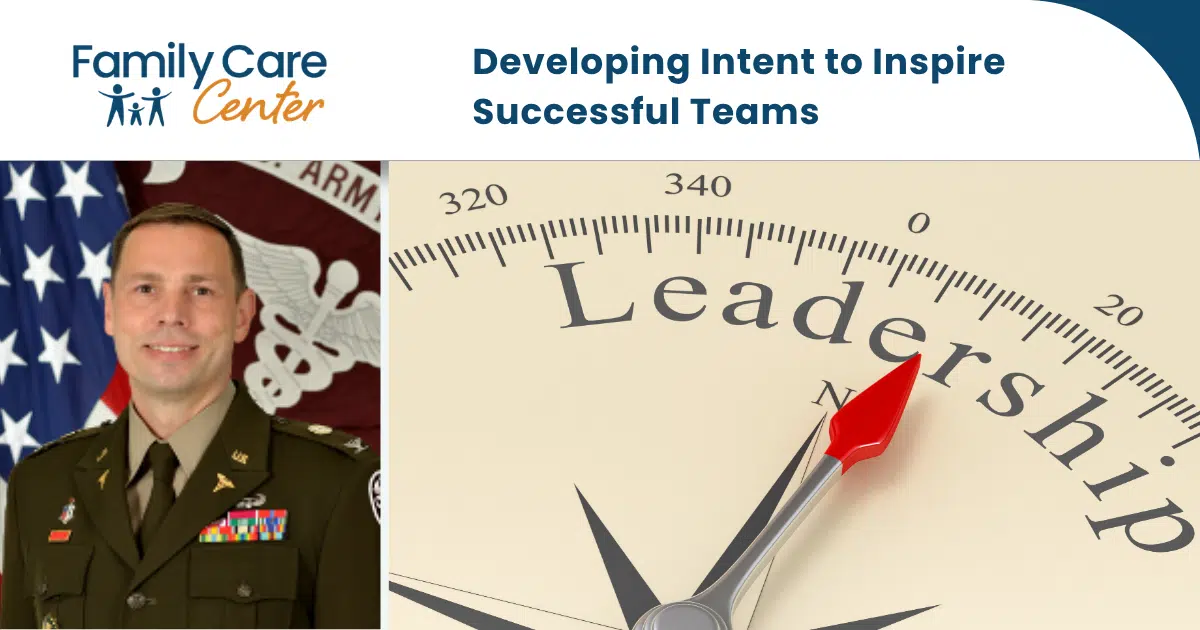
Leadership in behavioral health means inspiring ownership, building trust, and creating spaces where teams can do their best work. In February, Dr. Sam Preston, a psychiatrist and active-duty Colonel in the US Army, joined a Family Care Center leadership discussion to share what he has learned from leading military health care teams.
During the discussion, Dr. Preston explained how having a clear vision, setting priorities, and empowering teams can improve how organizations work. Family Care Center leaders used these ideas to build ownership, accountability, and high-quality care in their behavioral health teams.
Leadership begins with a clear vision
Dr. Preston learned that leadership is not about having all the answers. Instead, it is about creating an environment where teams can think for themselves, take action, and feel responsible for their work. During a staff leadership off-site early in his career, COL Preston took his leadership team to a submarine stationed at Pearl Harbor. Though it seemed odd that an Army Behavioral Health department would seek leadership lessons on a submarine, he wanted his team to see a command style, where the leader of the organization depended on “all hands-on deck” to avoid catastrophe. The submarine culture provided that opportunity: all heads were on a swivel, looking for risks to avoid and opportunities to capture.
On submarines, instead of one leader directing and 134 people doing what they’re told, the skipper had 100% of his team engaged – providing 135 thinking, active, passionate, creative, proactive people. Instead of giving direct instructions, he shared his intent and trusted that the people on his team would use their best thinking to execute that intent.
To succeed, this depends on two things: technical competence, which means making sure tasks could be done safely, and organizational clarity, which means understanding why each action was important for the mission.
Dr. Preston focuses on building teams that are proactive, engaged, and accountable. This same idea works in behavioral health clinics, where staff need both clarity and independence to serve patients well. When there is buy-in and a clear direction and goal, a team free to engage and solve problems is unstoppable.
Aligning values, priorities, and outcomes
Dr. Preston says it is important to define the “why” behind every action and connect it to the most important goals. At Blanchfield Army Community Hospital, he and his team started by figuring out what mattered most: the people, safe and effective health care, and the hospital’s mission of readiness. It’s something that can be replicated in any organization.
“First, define what’s important to you,” he shared. “What is our why? Why do we do the things that we do? Then develop them into priorities.”
In Dr. Preston’s example, his team chose no more than three main priorities and measured their progress. He reminded them, “If everything is a priority, nothing is a priority. Limit it to what truly matters.”
Behavioral health leaders can use the same approach. They can set clear, mission-driven priorities, bring staff together around shared values, and measure results in ways that support purpose and accountability.
Building a culture of trust and psychological safety
Dr. Preston encourages leaders to create a place where team members feel safe to share ideas, question assumptions, and try new things.
At Family Care Center, leaders build the same kind of culture. Staff are encouraged to speak up, work together, and take initiative, knowing their ideas matter. This helps everyone stay engaged, become more resilient, and perform better as a team.
Key takeaways from Dr. Preston
- Empower your team by giving intent, not instructions. Ownership drives engagement and accountability.
- Let your people be better than you. Respect and foster their expertise.
- Align values, priorities, and measurable outcomes. Focus on what truly matters.
- Build trust and psychological safety. Mistakes are an opportunity to learn.
- Set guardrails, then step back. Enable staff to make decisions within boundaries.
Dr. Preston’s experiences show that leadership is not about doing everything yourself. It is about creating the right conditions so others can do their best. Family Care Center leaders use these lessons every day, giving behavioral health teams the power to make decisions, take ownership, and provide compassionate, high-quality care.